UL 2849 E-Trike Safety Standard: How Addmotor Leads
The electric mobility market has dual realities today. While electric bikes and trikes are transforming urban transit and expanding outdoor mobility, a sequence of high-profile product failures has placed the entire industry under regulatory scrutiny. Between low-cost imports suffering from thermal runaway and tier-one manufacturers executing volume product recalls, the primary consumer matrix has shifted from performance metrics to verifiable engineering safety.
For consumers evaluating the electric tricycle segment, one technical designation is definitive: UL 2849. This represents North America's standard for electrical drivetrain safety. While numerous brands market individual "certified components," Addmotor has established an industry benchmark by securing full, whole-vehicle UL 2849 Listing Certificates from UL Solutions across its primary product line, including the Citytri E-310, Triketan M-330, Grandtan M-340, and Arisetan II M-360.
The Legal Mandate: Compliance is No Longer Optional
Regulatory frameworks governing micro-mobility have fundamentally shifted from voluntary guidelines to strict legal requirements. A critical turning point occurred with the enforcement of New York City’s Local Law 39. This statute makes it unlawful to distribute, lease, or commercialize any e-bike or e-trike within the municipality unless the complete electrical system has been certified to the UL 2849 standard by an accredited Nationally Recognized Testing Laboratory (NRTL).
This regional enforcement reflects a broader federal trajectory. The U.S. Consumer Product Safety Commission (CPSC) has issued formal directives to over 2,000 industry manufacturers, stating that non-compliant electrical architectures constitute an unreasonable risk to public safety. Consequently, the UL 2849 mark has become the mandatory baseline for legal market entry across the North American theater.
Professional Knowledge: Inside the UL 2849 Testing Architecture
A prevalent misconception among consumers is that possessing a "UL-certified battery pack" guarantees total vehicle safety. From an electrical engineering perspective, it does not. UL 2849 evaluates the complete electrical drivetrain as an interactive ecosystem, analyzing the operational harmony between the drive motor, controller, lithium-ion battery pack, Battery Management System (BMS), charging unit, and primary wiring harnesses.
To achieve compliance, the integrated system must withstand severe stress testing designed to simulate extreme environmental and operational abuse:
- Battery System Integrity (UL 2271): The underlying battery pack must independently satisfy UL 2271 standards, undergoing mechanical crush, drop, and thermal cycling protocols to ensure containment stability.
- Thermal Runaway Mitigation: The system firmware must safely isolate electrical overcharges and localized cell failures under high current loads.
- Environmental Protection (IPX4): Drivetrain components must remain sealed against multi-directional water ingress to eliminate short-circuit fire hazards during wet-weather operation.
- Material Flammability (UL 746C): All structural polymers and non-metallic enclosures must satisfy UL 746C flammability requirements, confirming robust flame-retardant properties.
The "Certificate" vs. "Report" Distinction: Why Continuous Oversight Matters
For the technical consumer, understanding the certification architecture is critical. Many budget brands frequently present a basic laboratory "Test Report" from third-party entities to claim their products are safe. However, there is a profound technical and regulatory gap between a one-time Test Report and a full UL Listing Certificate.
Test Reports (The Snapshot): A test report is merely a historical snapshot. It verifies that a single, golden sample provided by the factory passed a specific evaluation on a specific day. It offers zero operational guarantee that the mass-produced vehicles rolling off the line six months later are constructed using the same premium cells, flame-retardant plastics, or safety-critical BMS firmware.
UL Listing Certificates: This is the uncompromising methodology utilized by Addmotor. Secured directly through UL Solutions, a full UL Listing requires passing the initial destructive testing protocols, supplemented by mandatory, unannounced quarterly factory audits. UL field representatives visit manufacturing facilities without prior notice to audit production lines, verify component traceability, inspect quality control logs, and ensure that every single production unit perfectly matches the original certified design down to the component level.
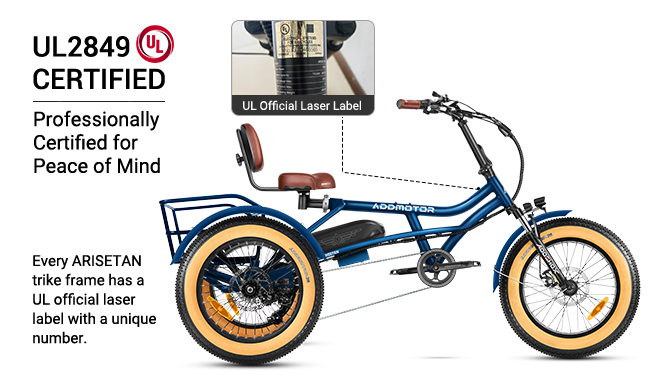
Addmotor provides this level of engineering transparency by laser-etching a unique, serialized Safety ID directly onto the frame of models like the Arisetan II M-360. This single-vehicle, single-code system allows riders and regulatory inspectors to instantly verify true, whole-vehicle UL 2849 compliance via the official database.
Analyzing Recent Market Failures: The Danger of Unverified Engineering
The necessity of independent third-party listing is illustrated by recent product failures across both budget and premium tiers of the micro-mobility sector.
The Ridstar Thermal Crisis: The CPSC issued a unilateral public safety warning directing consumers to immediately cease operation of Ridstar Q20 and Q20 Pro models. These uncertified units were implicated in at least 11 documented thermal incidents resulting in extensive property damage. Because the manufacturer failed to implement an acceptable voluntary recall framework, consumers were left with hazardous equipment and no regulatory path for remediation.
Mechanical Failures in Tier-One Supply Chains: Structural vulnerabilities are not limited to low-end imports. A major recall involving approximately 19,890 Trek and Electra e-bikes occurred due to embrittlement within the rear wheel fastening bolts, creating a risk of wheel separation during operation. Similarly, executed a structural recall for its Turbo Como SL forks following the identification of fatigue cracks in the steering tube assembly.
These incidents demonstrate that without rigorous quality management systems and continuous third-party factory auditing, structural and electrical failure modes can manifest within any tier of manufacturing.
Engineering Redundancy: How Addmotor Configures Its Certified Lineup
Addmotor has aligned its product development framework with these whole-system safety parameters, integrating technical redundancy across its certified multi-wheel fleet.
Citytri E-310: Compact Urban Infrastructure
Engineered for space-constrained residential environments, the Citytri E-310 features a full UL 2849 system listing, ensuring charging safety within indoor quarters. Driven by a 750W rear-drive motor assembly, the vehicle combines a folding structural frame with an advanced BMS architecture that constantly monitors voltage and thermal equilibrium across its 90-mile operating range.

Triketan M-330: Proportional Torque Delivery
The Triketan M-330 integrates an advanced torque sensor that reads rider pedal inputs to calculate proportional motor assistance. This eliminates the abrupt power surges typical of basic cadence-sensor logic, providing predictable control on steep gradients. The mechanical layout includes a rear differential gear network, allowing the rear wheels to rotate at varied velocities to maximize stability during tight cornering maneuvers.

Grandtan M-340: Enhanced Geometric Stability
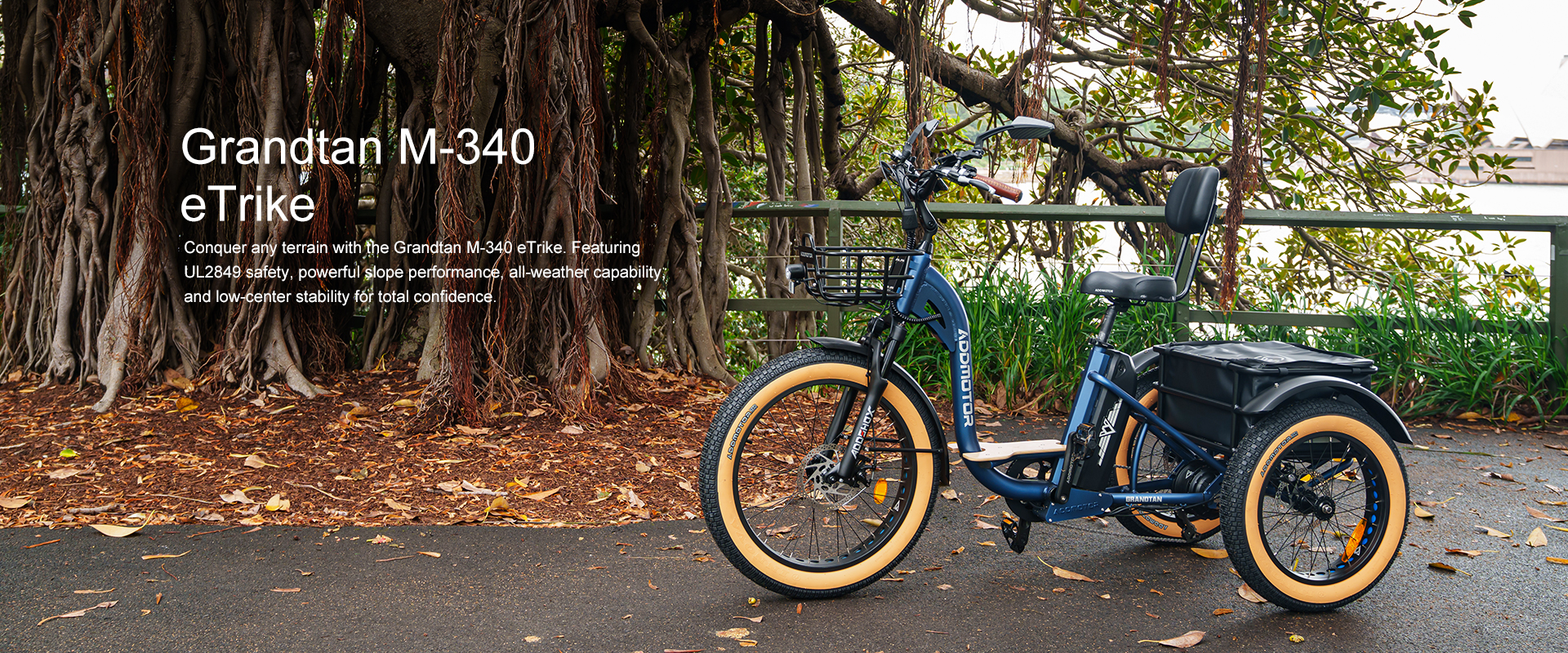
Built for variable terrain, the Grandtan M-340 pairs 4-inch wide fat tires with a robust mechanical rear differential to minimize the risk of chassis tipping on uneven or soft surfaces. Its 48V 20Ah Samsung battery pack is embedded directly into the UL-certified ecosystem, balancing high torque output with extensive thermal isolation.

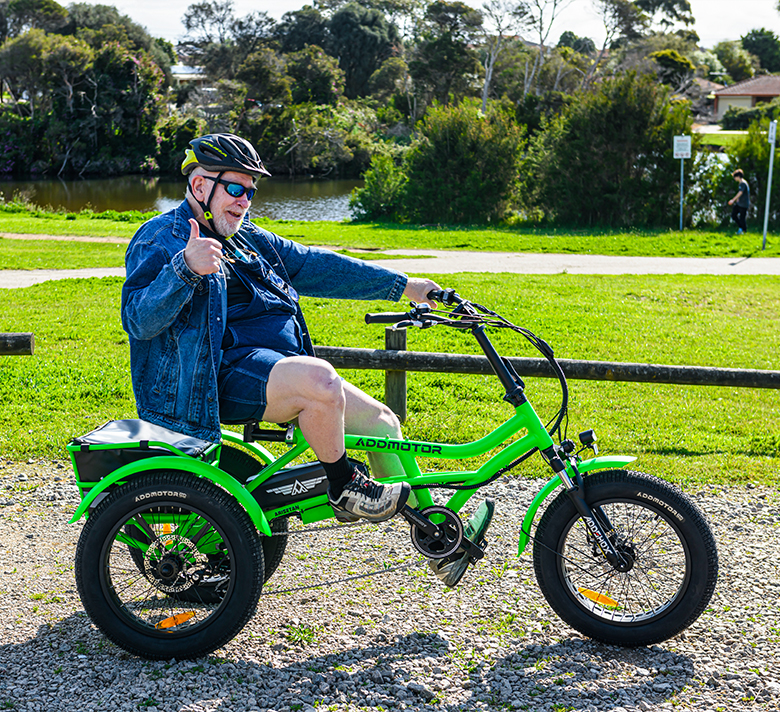
Arisetan II M-360: Ergonomic Semi-Recumbent Engineering
The Arisetan II M-360 introduces a semi-recumbent structural geometry designed to lower the vehicle’s center of gravity while reducing spinal load. This configuration provides inherent mechanical resistance to lateral roll. Like all current Addmotor trikes, the M-360 features a frame-etched Safety ID, providing permanent, verifiable proof of its whole-vehicle UL compliance status.
The Final Analytical Verdict
In a market landscape where drivetrain fires and mechanical recalls disrupt consumer confidence, procurement decisions must rely on independent verification rather than marketing claims. Addmotor’s capital allocation toward achieving complete UL Solutions whole-vehicle listing reflects a long-term commitment to engineering accountability.
Operating a Citytri E-310, Triketan M-330, Grandtan M-340, or Arisetan II M-360, means utilizing an integrated transit system that has been systematically analyzed from its terminal pins to its internal motor windings by the world’s primary authority on safety science. In the electric tricycle sector, Addmotor has transitioned from matching industry standards to establishing the safety benchmark.