Universal‑Joint Innovation on Addmotor Freetan M‑368X Full-Suspension Recumbent E-Trike
Addmotor Freetan M-368x Universal-Joint Innovation
Full‑Suspension Recumbent Electric Trike
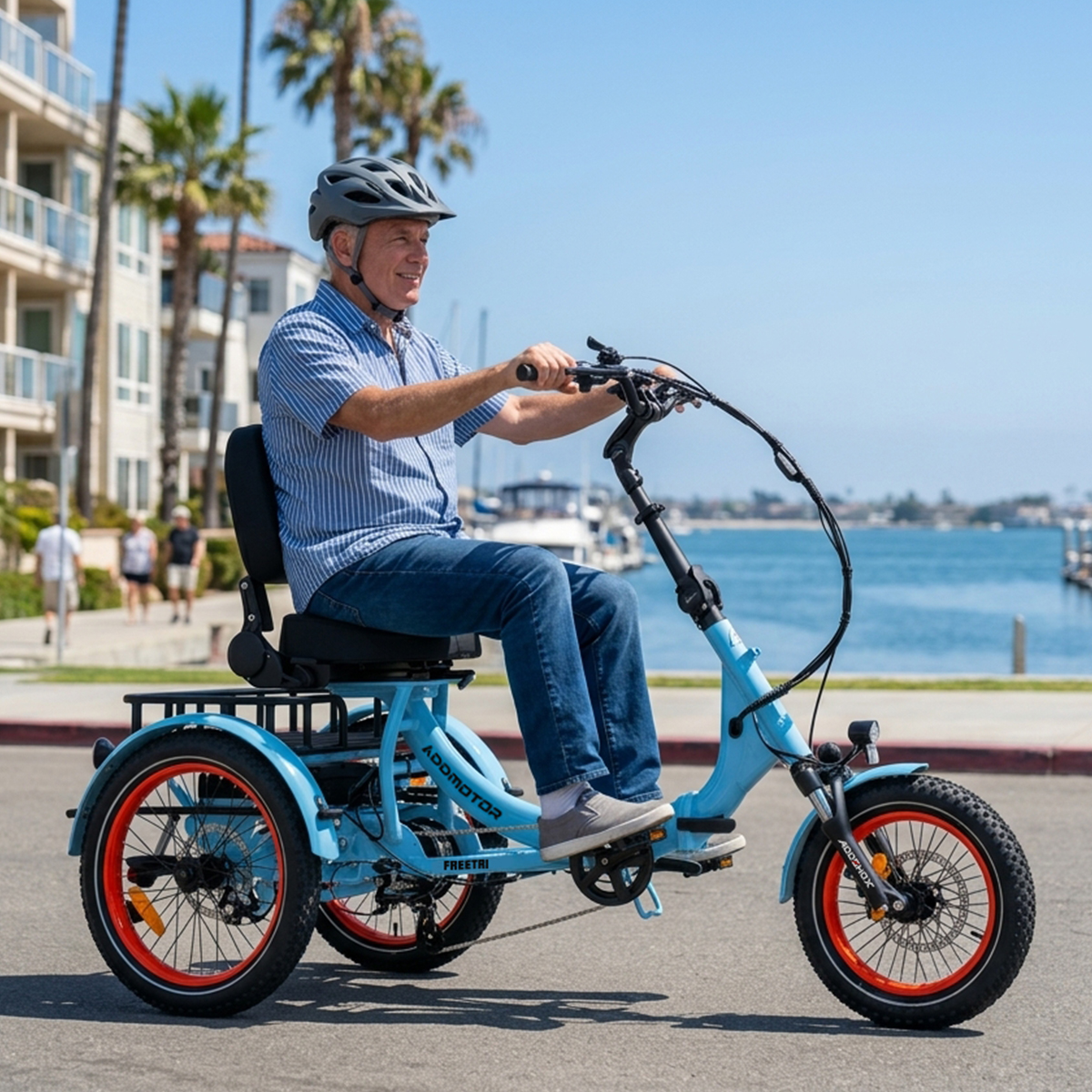
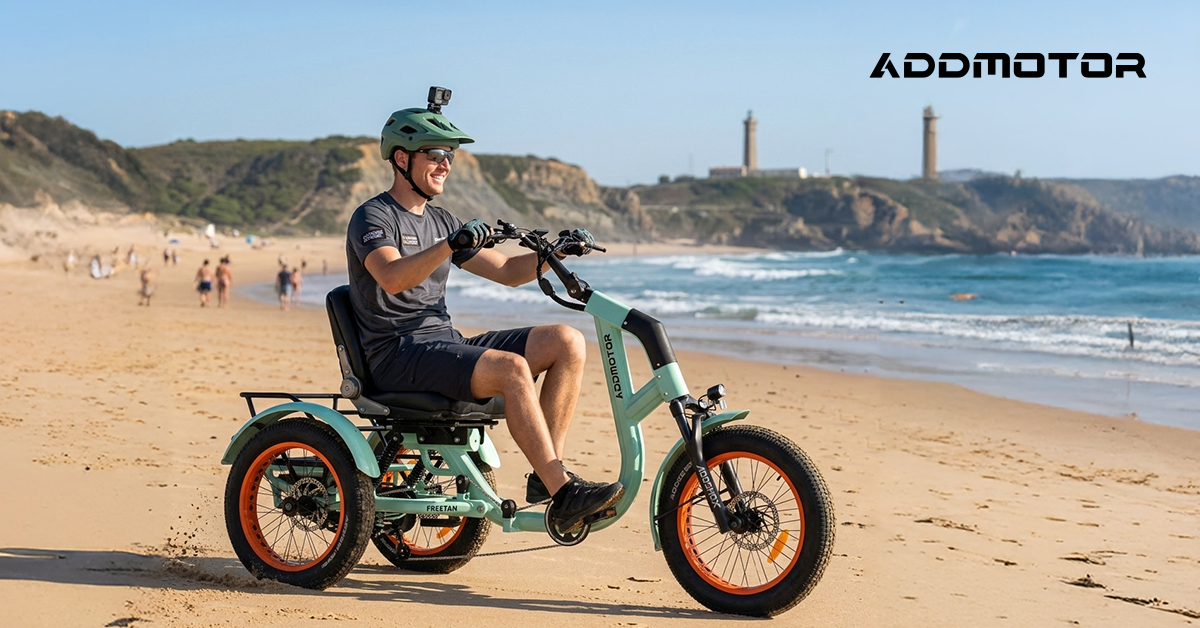
Addmotor Freetan M‑368X — the America's first universal‑joint semi‑recumbent electric trike, engineered for comfort and effortless control.
The M-368X employs a custom-designed two-section steel universal joint with a four-hole, zero-play design, completely breaking away from the traditional linear coupling between the front fork and handlebars. This structural innovation not only achieves stable transmission of steering force in terms of hardware, but also achieves complete decoupling of steering, suspension, and load absorption at the mechanical level: the near-vertical front fork design allows the suspension axis to perfectly match the impact vector, ensuring extremely sensitive shock absorption while significantly reducing the chassis height and eliminating the heaviness of low-speed steering, achieving a revolutionary unity of handling stability and ease of use.
By correcting the force distribution path, stabilizing steering dynamics, and expanding the usable steering envelope, the universal-joint system resolves the three structural limitations that have long constrained traditional inclined head-tube designs. These limitations include:
- Reduced suspension efficiency due to lateral shear stress.
- Elevated steering resistance (Wheel Flop) caused by aggressive rake angles.
- Restricted turning geometry, which limits the maximum steering angle and compromises maneuverability in confined spaces.
The following chapter provides an analysis of the mechanisms and performance implications that define the universal-joint system as the ideal solution for this vehicle category.
Structural Characteristics of the Universal‑Joint System
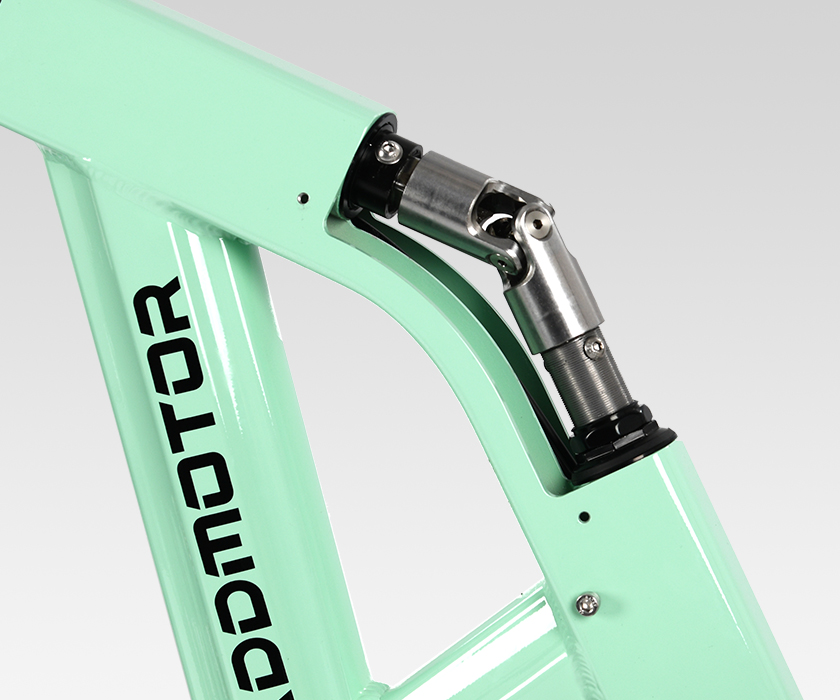
Moving beyond off‑the‑shelf U‑joints with inherent play, Addmotor engineered a precision‑machined steel gear‑mesh universal joint. This zero‑play mechanism eliminates steering looseness and delivers direct, high‑fidelity feedback, forming the structural core of the system’s handling advantage.
The M‑368X employs a custom two‑section steel universal joint that fully decouples steering from suspension motion. Positioned between the handlebar assembly and the front fork, this articulation allows the fork to remain nearly vertical for optimal shock absorption while steering occurs independently within the joint. With the suspension axis aligned directly to incoming impact vectors, terrain forces no longer interfere with steering, enabling steering, suspension, and load absorption to operate at peak efficiency without mechanical compromise.
Suspension Efficiency and Force Path Correction
Traditional inclined head‑tube systems position the fork and suspension at a significant angle. When the front wheel encounters a vertical impact, the force vector is decomposed into vertical and lateral components. The lateral component introduces shear forces that the suspension is not designed to absorb, reducing effective compression and degrading shock performance. The universal‑joint system corrects this misalignment by maintaining a near vertical load path. Impact forces travel directly into the suspension without being diverted into side loads. This alignment increases the effective compression ratio, reduces internal friction between fork tubes, and produces a faster and more predictable suspension response. The improvement is especially noticeable at low speeds and on uneven surfaces, where semi‑recumbent tricycles are most sensitive to front‑end disturbances due to their extended wheelbase and low center of gravity.
Steering Dynamics and the Elimination of Wheel Flop
In traditional systems, steering requires tilting the entire fork assembly around an inclined head tube. This tilt shifts the front wheel’s contact patch relative to the steering axis, generating a destabilizing torque commonly known as wheel flop. The rider must counteract this torque, which results in heavy, delayed, or inconsistent steering. The universal‑joint system eliminates this behavior by separating steering rotation from fork tilt. The front wheel remains vertically aligned during steering, preventing the sudden downward tipping that characterizes wheel flop. Steering torque is significantly reduced because the rider no longer needs to overcome the leverage created by the head‑tube angle. The result is a light, linear, and predictable steering response that can be controlled comfortably with one hand. This improvement is particularly important for older riders, smaller riders, and users with limited upper‑body strength, who often struggle with the mechanical resistance of traditional designs.
Turning Geometry and Spatial Freedom
Traditional inclined-fork systems suffer from geometric interference and extended mechanical footprints. As the fork tilts during steering, the upper fork crown or handlebar assembly can collide with the main frame. This physical interference, combined with the "front-end extension" typical of slack head-tube angles, severely limits the maximum steering angle and artificially increases the minimum turning radius.
The universal-joint system bypasses these limitations by maintaining a near-vertical fork alignment. Because the fork does not follow a tilt-induced path, steering rotation occurs internally within the joint, allowing for a significantly larger usable steering angle without the risk of mechanical collision.
Consequently, semi-recumbent electric tricycles equipped with this architecture can achieve a minimum turning radius as small as 2 m. This engineering breakthrough enables the vehicle to perform a complete 180° turn within a standard single lane. This capability dramatically improves low-speed maneuverability, parking convenience, and navigation in confined urban environments, offering a level of agility previously unattainable for long-wheelbase electric trikes.

One‑Piece Frame Architecture: Industry‑Leading Structural Craftsmanship
Beyond the front‑end steering breakthrough, the Freetan M‑368X is built on an equally advanced structural foundation: a single‑piece, large‑radius bent aluminum main frame. The primary load‑bearing tube is formed from a continuous aluminum section bent over 90° without any welding joints—a manufacturing capability possessed by only a handful of high‑precision factories worldwide. Eliminating welds in the main stress path removes the weakest points typically found in multi‑piece frames, resulting in higher torsional rigidity, improved fatigue resistance, and a dramatically cleaner structural load flow.
This one‑piece architecture is complemented by fully internal cable routing. All electrical and mechanical lines run inside the frame, protected from external abrasion and environmental exposure. The absence of exposed cables not only enhances durability but also elevates the vehicle’s visual quality, giving the Addmotor Freetan M‑368X a premium, integrated appearance rarely seen in the electric trike category. The combination of seamless structural geometry and hidden cable pathways reflects a level of craftsmanship typically reserved for assemblies.
Together, the universal‑joint steering system and the one‑piece frame architecture form a unified engineering platform: a front end optimized for precision and stability, anchored to a frame designed for strength, longevity, and aesthetic refinement. This integration ensures that the mechanical advantages of the steering system are fully supported by a frame capable of transmitting forces cleanly and predictably, completing the structural foundation of the M‑368X.
Addmotor Freetan M‑368X vs HP Velotechnik Delta TX
| Feature Specs | Addmotor FREETAN M‑368X | HP Velotechnik Delta TX |
|---|---|---|
| Front‑End Architecture | Universal‑Joint Steering (decoupled steering & suspension) | Traditional Inclined Head Tube (no U‑joint) |
| Fork Geometry | Near‑vertical front‑fork alignment | Slack head‑tube angle with significant tilt |
| Steering Mechanism | Steering rotation is fully decoupled from suspension movement | Steering requires tilting the entire fork, causing instability |
| Typical Issues | No wheel flop, no front‑end drop, stable low‑speed control | Wheel flop, heavy low‑speed steering, front‑end instability |
| Engineering Advantages | Easy to operate and highly stable | Must overcome head‑tube leverage; higher steering resistance |
| Minimum Turning Radius | ≈ 2 m, capable of a full 180° turn in a single lane | Not specified; limited by fork tilt and frame interference |
| Low‑Speed Handling | Extremely stable; no wheel flop, precise control | Pronounced wheel flop; requires more effort to stabilize |
| Full-Suspension | Yes | No |
| Urban Maneuverability | High — agile in tight spaces | Moderate — restricted by steering geometry |
System‑Level Performance Integration
The universal‑joint steering system produces a holistic improvement across all front‑end performance metrics. Ride comfort increases due to higher suspension efficiency and reduced internal friction. Handling stability improves because steering behavior becomes predictable and free from wheel flop. User accessibility expands as steering effort decreases, making the vehicle easier to control for a wider demographic. Urban maneuverability benefits from the reduced turning radius and the absence of spatial interference. Mechanical longevity also improves because the suspension no longer experiences side loads that accelerate wear.
Conclusion:
The universal‑joint steering system establishes the optimal front‑end architecture for semi‑recumbent electric tricycles by realigning the suspension force path, eliminating tilt‑dependent steering dynamics, and expanding the available steering geometry. It resolves the three structural limitations inherent to traditional inclined head‑tube designs: reduced suspension efficiency, heavy steering resistance, and restricted turning capability.
When paired with the Addmotor M‑368X’s one‑piece, large‑radius bent aluminum frame—free of welds in the primary load path and reinforced by fully internal cable routing—the advantages of the universal‑joint system are amplified at the chassis level. The frame’s higher torsional rigidity, cleaner force transmission, and premium integrated construction provide the structural foundation required for the steering system to perform at its full potential.
These innovations enhances every dimension of vehicle behavior: suspension response becomes more efficient, steering becomes lighter and more predictable, stability increases at both low and moderate speeds, and maneuverability improves dramatically in confined spaces. The result is a front‑end and architecture that delivers superior performance, safety, comfort, and accessibility—representing the most advanced and effective structural solution currently available for long‑wheelbase, semi‑recumbent electric tricycles.

New Product Launch: Introducing the Addmotor Freetan M‑368X
The engineering principles outlined above demonstrate that a universal‑joint steering architecture is not merely an incremental refinement but a structural redefinition of how a semi‑recumbent electric tricycle should behave. Once the front end is freed from the compromises of inclined head‑tube geometry, the riding experience changes in ways that are immediately perceptible to the user. Impacts are absorbed cleanly along a near‑vertical load path, steering becomes calm and effortless, and tight‑radius maneuvering becomes a natural extension of the vehicle’s capabilities.
Comfort is no longer a secondary outcome of suspension tuning but a direct consequence of correct mechanical design. To complement the universal‑joint front end, the M‑368X employs a rear suspension system that works in concert with the near‑vertically aligned front fork, creating a full‑body shock‑management platform that maintains stability and comfort across uneven terrain. This suspension performance is further reinforced by the trike’s one‑piece, large‑radius bent aluminum frame—a continuous, weld‑free main tube that delivers higher torsional rigidity and cleaner force transmission than multi‑section frames. With fully internal cable routing integrated into the chassis, the structural system remains both mechanically protected and visually streamlined, eliminating exposed lines and reducing long‑term wear.
This transformation is fully realized in the Addmotor Freetan M‑368X, the USA's first recumbent electric trike built around an universal‑joint steering system. By integrating this architecture with a rigid, seamless frame platform and an ergonomically reclined long‑wheelbase layout, the Addmotor Freetan M‑368X delivers a level of smoothness, stability, and low‑effort control that traditional front‑end designs cannot approach. The result is a riding experience defined by comfort in every dimension: comfort in suspension response, comfort in steering behavior, and comfort in maneuverability, even within the tightest urban spaces.

Next Article: A Full Breakdown of the Addmotor Freetan M‑368X
As this chapter concludes the analysis of the universal‑joint front‑end architecture, the next article will expand the Freetan M-368X.
Product Access: https://www.addmotor.com/products/freetan
For a complete introduction to the Freetan M-368X, please visit: Addmotor Freetan M‑368X: The Next‑Gen Recumbent Electric Trike for Unmatched Comfort & Control